

It says something when the returning champion of the 2017 Citi Open is neither at the very top or the very bottom of the draw.
If Gael Monfils was expecting to have it easy retaining his title, that #6 next to his name should disabuse him of that notion. The quality of the field boasts no less than 4 returning champions, including Juan Martin del Potro, Kei Nishikori and Milos Raonic, and of course, the Gael Force. That's the most crowded field of former champions since 2013, when James Blake, Lleyton Hewitt, Juan Martin del Potro and Alexander Dolgopolov strapped on their headbands for another bite at the apple. Throw in former finalists John Isner, Vasek Pospisil, Marcos Baghdatis, Gilles Muller and if experience is of significant value to progressing in DC this summer, the rest of the field should scarcely stand a chance.
But the #1 seed this year is none other than Dominic Thiem, a player whose rise to the top 10 of the game has been striking, culminating in his best performance at a major, making the semi-final at Roland Garros this year, losing to some fellow whose won it here and there. It's not the first time he's been seeded #1 at an ATP event, but certainly this one, and could be the first Austrian to win here in the history of the tournament, one that neither Thomas Muster, nor Jurgen Melzer could claim.
Thiem awaits the winner of 2014 Finalist Vasek Pospisil, fresh of his stunning performance as the best man at his brother's wedding, and Switzerland's Henrik Laaksonen who gained direct entry with an ATP ranking of #95. Pospisil, for his part, will look to justify his superior rank of #72, and for redemption following some valiant, but no less dodgy performances in the Davis Cup earlier this year, before his countryman Shapalov became a major party-pooper and obliterated the umpire's eye socket with an errant ball hit in anger. My guess is Pospisil will make it through to challenge the #1 seed for a place in the 3rd round.
Malek Jaziri will enjoy stirring support from the large community of North Africans and francophones in the D.C. area, as he takes on Alessandro Bega, an Italian journeyman who didn't drop a set in qualifying for the main draw. Bega's stiff legged stroke production on his two-handed backhand, will make him susceptible to the variety and court awareness that the vastly more talented Jaziri demonstrated last year to beat Reilly Opelka and take Sacha Zverev to 3 sets. His experience frustrating taller ball-busting opponents will put him in a good position to meet the challenge of a resurgent Kevin Anderson who lost a hear-breaker to Sam Querrey this year at SW19. Anderson is a consummate professional, whose serve is huge, as is his forehand, but struggles with movement and balls out of his strike zone, which is curiously, but expectedly, small for a man of 6'8"- the kind of tree Jaziri is accustomed to chopping down.
Mischa Zverev is seeded at the Citi Open for the first time in his career, following a resurgent 2017 where he outperformed his baby-brother in Australia, beating World #1 Andy Murray along the way, and later put up committed but ultimately insufficient resistence to 2017 Wimbledon champion Roger Federer. Fortunately he is on the opposite end of the draw from "der Kleine", and will not have to deal with facing him unless they both make the final: not an indistinct possibility given their level of play this year. To get there, he'll have to start of with a win over the winner of Indian 22-year old Ramkumar Ramanthan, who made the Challenger final in Tallahassee this year, on the way to a 6-2 tour level record, and Guido Pella, the Uraguayan journeyman who give Grigor Dimitrov fits in the juniors and nearly sent him packing in the second round here in 2015. Pella is the more experienced player, but something tells me that Ramanthan, also likely to have support from the enormous Indian community in the D.C. area will continue the form that saw him qualify as the top seed, with an easy win over Marinko "Mount" Matosevic.
19-year old Stefan Kozlov, an American by way of Macedonia, seeks to right the ship of a disastrous 2017 at the ATP tour level, winning only 2 of his 9 matches, by getting the job done over Yuki Bhambri, the 25 year old Bolletieri Academy offspring who has done little to justify all the Indian hopes and dreams heaped on his spindly frame over the last 7 years. Surprisingly, it is Bhambri who had to come through the qualifying, which he did by dispatching of Liam Broady (Naomi's brother) in straight sets over the weekend. Fitness questions have dogged the young pretender with Bollywood good looks, so the quick work will facilitate what could be one of his last chances to breath through to the big stage. My guess is that Kozlov is hungrier and in a sprint, the more likely to face the defending champion in the next round. Regardless, don't expect either to make it to the 3rd round.
Milos Raonic returns after an absence of two years to threaten the craniums of center linesmen throughout Rock Creek Park with his howitzer serve, as the #3 seed. There aren't many in the draw that can deal with the power of not only his serve, but his forehand, and if there's one player who will have no qualms about facing anyone in the draw, it's Raonic. Following a subdued performance against the Maestro of all Maestros at Wimbledon, I'm guessing he'll make it through his quarter of the draw, to kick off his summer 2017 season. To do so, he'll need to get past the winner of Nicolas Ma"who?"hut, and the little Italian veteran Thomas Fabbiano "not Fognini", who moves and hits like the mercurial shotmaker extraordinaire, with only a sliver of the talent. I see Mahut giving Raonic a run for his money in the next round.
Ryan Harrison has earned himself a bye into the second round as the 16th seed, and where he will face the winner of Edan Lesham and 2006 Australian Open finalist (yes, 11 years ago) Marcos Baghdatis. Baghdatis is a former finalist here, and while he's played this even many times over the years, has not had a great deal of success since he lost to David Nalbandian in 2010. His best years are behind him, but I don't see him succumbing to the 20-year old Israeli playing his first tour level match of 2017. This is a throwback to an era of players who rely more on their hand-eye coordination and court sense, as both are endowed with a superior level of both qualities. In a battle of wits, the Cypriot looks like the best bet to face the resurgent American seed in round 2. The respite from round 1 will serve Harrison well after a tough two tie-break set loss in the final of Atlanta.
Speaking of Atlanta, John Isner, straight off of his 4th title in Atlanta, comes to DC looking to make his 4th final, after losing his first to Andy Roddick, his second del Potro, and his third to Nishikori. Roddick is long since retired, but Isner will have a shot at revenge for one of those two losses as long as his gets through to the final. In his way is his Wimbledon nemesis, "He said" Dudi Sela and Jared Donaldson, an American who performed well here last year, but is yet to see his career really take off like his contemporary, the boy Emperor Alexander. Sela is crafty and will enjoy large support, while Donaldson will seek to justify his direct entry into the main draw, and I'm picking Sela to get what's coming to him from Isner in round 2.
The top half of the draw is filled out by Sekou Bangoura, Jr., coached by his eponymous father, a 25-year old American who uses a very light stick, and as such generates enormous racquet-head speed and spin, but not much penetrating power. He also struggles to win 2nd serve points, which will make it very difficult to overcome the old pro from Arad, Romania, Marius Copil. One of the few players in the draw with a single handed backhand, Copil's main quality is his athleticism and guile, which he should use to overwhelm the slightly built Bangoura. Particularly since the bigger, stronger, faster version of Bangoura awaits him in the 2nd round if he wins, Jack "the Rock" Sock. At 6300 RPMs, Sack puts more energy into his forehand than any other forehand in the history of tennis...that's right, the history of the game. I don't know why that hasn't translated into more at this level - perhaps one or two fewer trips to Chipotle with Pospisil would help - but my guess is Sock is a lock to beat Copil in the next round.
Sasha Zverev will have a lot of work to do to get through a very difficult bottom half of the draw, but I don't see much in the way of impediments in the next round, as he faces the winner of Australian Jordan Thompson and the Belgian Ruben Bemelmans. Assuming "Flock of Seagulls" does what he ought to do in round 2, he'll face the winner of Nick Kyrgios and the winner of Go "Go-Dane?" Soeda and...I shit you not...Tennys "Anyone" Sandgren, from Gallatin Tennesee. I mean this fellow had to be destined to be a professional with a name and hometown like that, but the chances of him getting past Soeda, the mercurial pugilist from Tokyo, are slim to none. Whoever faces Kyrgios, based on what we've seen from him since Miami, we could be looking at a walkover or a double bagel. But this will be the first time that Nick "not a Prick" Kyrgios will take the courts at the William H. Fitzgerald tennis center. I'm hoping he brings to bear the full weight of one of the best serves, and innately powerful forehands, in all of tennis...I'm hoping.
Steve Johnson comes to DC for the first time since the passing of his father, and one would hope he would have some respite from what's been a very emotional 2017. This has been the tournament where he consistently performs the best, with impressive wins over Dimitrov and Tomic the "Tank Engine" 2 and 1 years ago respectively. I can see Johnson making a run, but I wonder if it wouldn't actually do him some good to lose early and regroup in Canada or maybe Cincinnati. In any case, Johnson will face the winner of Reilly Opelka and Daniil Medvedev. All 7'0 of Opelka will be brought to bear to irritate the hell out of the highly irritable Medvedev, who has accused umpires of everything from racism to being bought. Here in DC, with the current popularity of Russians, he'll have entirely different set of things to hang a loss on if Opelka figures out how to use that serve to his advantage. My guess is that Medvedev and Johnson will renew the Cold War in round 2. Hopefully, nobody from the Trump administration will be caught asking Medvedev for an autograph.
4th seed Grigor "Gimmemore" Dimitrov will face the winner of Kyle Edmund and Heong Chung. Edmund, who started playing tennis about 7 years later than all of his rivals, will have the unenviable task of standing up Hyeon Chung, the tallest and strongest Korean player since...well, ever. Chung actually put in a very tough performance against Dimitrov a couple of years ago in Australia this year, but I don't see him getting past Edmund. And my guess is that Dimitrov, who's never had a particularly good summer throughout his 8 years on tour, will continue to struggle in DC, as he has since he first came here in 2011, and lose for the second year in a row to a journeyman Brit...this one not on cocaine.
At the bottom of the draw, but right at the top of my favorites to take the title here, are the fastest hands in tennis, belonging to the little maestro from the land of the rising sun, Kei Nishikori. Two years ago, if your eyes were able to perceive motion that fast, you would have seen him use those hands to fend of three of the most gargantuan serves in the history of tennis. First, he stood up to the fastest recorded serve in tennis history, that of Sam "the Mesomorph" Groth, then in a rematch of his US Open final loss in 2014, he served up a nice hot cup of sweet revenge on "Cheech" Marin Cilic, before besting the behemoth John "the Booming Baptist" Isner for his first title here, and his second ATP 500 of 2015.
He'll need warp speed reactions to get through his half of the draw, which is stuffed like a sausage link with flame throwing seeds, Alexander "the Great" Zverev, "Gimme More" Grigor Dimitrov, "Naughty" Nick Kyrgios, "My name is" Lucas Pouille, "Chill" Gilles Muller and "Not" Juan "and Done" Martin del Potro. If he can get past the American civil war between Donald Young "and Restless" and "Gentleman" Tim Smycek, he'll have the winner of delPo's second round match up with the winner of Alexios Halebian and "Loopy" Lukas Lacko.
Lacko, a talented Slovakian, appears to eschew neither hamburgers nor wildcards, although he's deservedly received direct entry here. By contrast, Halebian beat two seeded players to force his way into the show, and will have the opportunity, if not the rest, to prove that his 2012 Kalamazoo final was no fluke. A bounding, athletic lefty, Halebian relies on a serve that is the spitting image (if not effect) of Goran Ivanesevic's monstrous ball-in-hand delivery, which he'll need against Lacko's outstanding return. I'm betting on Halebian lacking against Lacko, and his long hard road into the main draw coming to an abrupt end.
For his part, Donald Young, a Kalamazoo winner in 2006 (over his more illustrious opponent that year, Sam Querrey) returns to DC not as a fan favorite, but perhaps as a sentimental one. 10 years have passed since he first played here in the summer of 2008, and while he's bulked up his body, his game appears to be more or less the same relative to his contemporaries. Experiencing something of a resurgence in his career over the last two years, it would be nice to see Young win a few matches here, but the depth of field makes it unlikely that this tournament would constitute his maiden title on the ATP tour.
Tim Smyzcek, who needlessly handed Rafael Nadal a first serve in Australia (ostensibly because a fan called out during the Spaniard's delivery), and was applauded for his sportsmanship by all but this writer and probably his coach, nearly unimaginably beat the Lieutenant G.O.A.T. in 2015. A quick and tenacious defender, his lack of power is precisely the kind of opponent upon whom Young could impose himself. Unfortunately for Young, and fortunately for this match up, Smyzcek possess all the competitiveness that Young lacks, and I see this being a 3 set slog that the 29 year old Wisconsiner comes through in a squeaker.
Dmitry Tursunov hasn't been heard from in D.C. for quite some time, but a protected ranking gives him direct entry into the field. He made news, tangentially, when Colin Cowherd incorrectly identified him as the 700th ranked player that Serena Williams couldn't beat - in fact his ranking today is #820 - and nobody is expecting the obvious to be proven today, although it is likely he will struggle to get past the 6'2" Texan Mitchell Krueger "Industries". For the 34 year old Davis Cup hero of 2006, there are definitely more yesterdays than tomorrow, and unlike his contemporary, Roger Federer, the years have not been kind. My guess is that Krueger, who somehow dropped about 50 places in the rankings since May (to #223), will have a good day at the office...lunch pail, and all, and move on to the man who has stolen the mojo of everyone from Andy Roddick to Rafa Nadal in Gilles Muller.
Muller is a former junior #1, with the the most mind and body bending lefty serve in modern tennis. Not the most aesthetic player in the world, he is very effective on fast surfaces that allow him to follow that dastardly serve, casually into the net, which is precisely what the stadium court does. Unfortunately for him, he'll probably relegated to the outer courts until the quarterfinal diminishing his chances...but he'll get past Krueger.
Tune in tonight for a recap of day 1...
SUBSCRIBE

 Posts
All Comments
Posts
All Comments
Monday, July 31, 2017


Monday, August 1, 2016
TIM MAYOTTE AND TECHNIQUE...ALWAYS TECHNIQUE
I came across a clip of Tim Mayotte speaking this year at The Tennis Congress, about the fundamentals of technique in tennis. As I watched it, I honestly felt a flutter of emotion at the realization that I am not alone in the notion that the game of tennis has always has been, and ever will be, about technique...always technique.
Please note that there a number of videos about the modern forehand, which players apply it, which players do not, that may be more extensive and involved than this one: this is just a clip. But it is special because of the subject: Tim Mayotte. Yet another quiet American who went about his illustrious career with more than just professionalism, commitment, tenacity and results: he did, and still does it, with honor.
It was with honor that I was a ball-boy at the 1989 Sovran Bank tennis classic, from which Mayotte emerged the victor, over another American who was anything but quiet, one Brad Gilbert. It was the final victory on the ATP tour of Mayotte's career, and while I didn't play a serve and volley game, nor did I have the gifts or physique of Mayotte, I learned from him a great deal about how powerful and imposing the graceful mechanics of the game can be. If you've never seen him play, you will no doubt recall how he aligned his imposing physicality, with a focused set of skills, employed to a specific set of tactics, in pursuit of the strategic of objective of applying pressure to one's opponent...relentless, ceaseless, unflinching, pressure point after point after point.
In this classic confrontation between the player who absorbs pressure, versus he who imposes it, Mayotte prevailed as he did two years earlier for the (2nd) biggest title of his career at Bercy (he also won the Miami Masters - then called the Lipton International - in 1985, when it was a "grand slam light" two week, best of five event from the quarterfinals on). Note the jump-started entry into the court following his serve with the right foot planted at once gracefully and authoritatively and first, allowing his momentum to carry him forward and close in on the net. Note the quadricep burning deep knee bend, over and over again, keeping his body positioning consistent regardless of what the ball does, precisely to eliminate as many variables from the stroke as possible to, in order to create consistency.
That's right - it's no accident that the players who are the most consistent are the ones who adhere to the most fundamental principles of technique. So it should come as no surprise that Mayotte, a winner of 12 career titles, a semi-finalist at Wimbledon and Australian Open (at the time on grass) would be at the front lines of extolling the virtue of focusing tennis instruction in the US on the bio-mechanics of technique...after all it served him so well from his NCAA title in 1991, and throughout his 12-year career professional career. A career that included a silver medal at the Olympics in 1988, and representation of the United States in the Davis Cup. If we can do, from the grassroots, what our American forbearers did to become the best in the world, there is hope yet for American men's tennis.
Tim Mayotte: always a gentleman, always technique...always technique.
Thursday, July 28, 2016
2016 CITI OPEN: WRAP UP AND TENNISFILES PODCAST
So long, 2016 Citi Open: you came and went too soon, but it was well worth the wait. Here's episode 26 of Tennis Files podcast, by Mehrbad Iranshad. It's always a pleasure talking tennis with him, and I hope you enjoy it too.
If you haven't already, and you play (or just love) tennis , I really encourage you to have a look at Tennis Files by Mehrban Iranshad The information in it is really comprehensive: from technique, to tactics, to fitness, to game planning: you name it, he's got it, and he doesn't rest on his laurels - there's always something to go back for and have another look.
The topics and guests on his podcasts are fantastic: from juniors hoping to make the jump, to professionals who ply their trade, to former gladiators reminiscing about their days on tour. And there's the stuff about improving your game, from picking the right strings, to the right coach, to the top 7 reasons you lose a tennis match...like I said, it's comprehensive.
Well, once again thanks to everyone at the Citi Open for a great year, to my colleagues who were once again great to be around, to the players for making the spectacle, and (my fellow) fans for making it possible.
See you in 2017!
If you haven't already, and you play (or just love) tennis , I really encourage you to have a look at Tennis Files by Mehrban Iranshad The information in it is really comprehensive: from technique, to tactics, to fitness, to game planning: you name it, he's got it, and he doesn't rest on his laurels - there's always something to go back for and have another look.
The topics and guests on his podcasts are fantastic: from juniors hoping to make the jump, to professionals who ply their trade, to former gladiators reminiscing about their days on tour. And there's the stuff about improving your game, from picking the right strings, to the right coach, to the top 7 reasons you lose a tennis match...like I said, it's comprehensive.
Well, once again thanks to everyone at the Citi Open for a great year, to my colleagues who were once again great to be around, to the players for making the spectacle, and (my fellow) fans for making it possible.
See you in 2017!
Sunday, July 24, 2016
2016 CITI OPEN FINAL: THE AIR UP THERE
Let's be honest - that started out the worst final I've ever seen. Not just at the Citi Open, mind you. Even Newport had some agonizing misses, friendly/ruthless netcords, and what passes for moments of intrigue in any match featuring the long arm of the Croatian law. But in the beginning, there was almost none of that today. The rhythmic clapping that entreats a favored gladiator to make the next point count, made its first appearance, rather apathetically it must be added, upon Monfils' evening the score on Karlovic's serve for the first time...at 15-15. There were three break points averted in the last game of the first set, but the hand held fans waddled more energetically than the hands clapped after each of them was disposed of in depressingly similar fashion.
In fact the writing seemed to be on the wall in the very first game of the match. Despite his much ballyhooed improved serve, which elicited 42 aces in 4 matches, Monfils struggled to hold his serve in the face of returns more befitting Djokovic than Karlovic, and a spring in his step that would have made Dolgopolov proud. It was hard to tell on his 6'11 frame, but I promise you it was there. Karlovic on the other hand sailed through his first 5 service games hitting more aces than faults, an ominous statistic speaking to both his efficiency and Monfils' profligacy. In the end both translated into a first set that was about as dramatic as a bullfighter standing in the middle of the ring with an elephant gun.
There was a kind of resignation in Monfils, even as he himself began drumming aces in the second set. It was almost as if he, a participant in this macabre exercise in Japanese pantomime, resented being a part of it. Serving his 3rd ace of the game to close out the 6th game with just one point dropped on a running forehand pass up the line from Karlovic, he appeared to initiate a jig of celebration...but as he looked down to find his feet, it was evident that he had merely tripped over himself. Karlovic, on the other hand, was full of merriment, as he gracelessly took the hot air right out of the stadium time after time, with irritating examples of the full repertoire of shots he possesses: drop volleys, inside in forehand approaches, slice returns landing 6 inches from the base and side lines.
In fact, one could argue that the better he played, the more the sanguine spectators, looking down their noses at the combattants like the Plebeians at the Colosseum, rooted against him. One almost began to wonder if there wasn't something more philosophical in the desire to see Monfils emerge victorious from this encounter, as he had in fact, been the worse player for the better part of an hour and 1 and 15 minutes. But the match turned on two things that both energized Monfils, and seemed to demoralize Karlovic.
In fact the writing seemed to be on the wall in the very first game of the match. Despite his much ballyhooed improved serve, which elicited 42 aces in 4 matches, Monfils struggled to hold his serve in the face of returns more befitting Djokovic than Karlovic, and a spring in his step that would have made Dolgopolov proud. It was hard to tell on his 6'11 frame, but I promise you it was there. Karlovic on the other hand sailed through his first 5 service games hitting more aces than faults, an ominous statistic speaking to both his efficiency and Monfils' profligacy. In the end both translated into a first set that was about as dramatic as a bullfighter standing in the middle of the ring with an elephant gun.
There was a kind of resignation in Monfils, even as he himself began drumming aces in the second set. It was almost as if he, a participant in this macabre exercise in Japanese pantomime, resented being a part of it. Serving his 3rd ace of the game to close out the 6th game with just one point dropped on a running forehand pass up the line from Karlovic, he appeared to initiate a jig of celebration...but as he looked down to find his feet, it was evident that he had merely tripped over himself. Karlovic, on the other hand, was full of merriment, as he gracelessly took the hot air right out of the stadium time after time, with irritating examples of the full repertoire of shots he possesses: drop volleys, inside in forehand approaches, slice returns landing 6 inches from the base and side lines.
In fact, one could argue that the better he played, the more the sanguine spectators, looking down their noses at the combattants like the Plebeians at the Colosseum, rooted against him. One almost began to wonder if there wasn't something more philosophical in the desire to see Monfils emerge victorious from this encounter, as he had in fact, been the worse player for the better part of an hour and 1 and 15 minutes. But the match turned on two things that both energized Monfils, and seemed to demoralize Karlovic.
Karlovic left a half volley short in the court, but no where near short enough to be out of range of his majestic moving rival. Monfils, sensing the moment, charged forward, slid into a frying pan forehand aimed ruthlessly at the trunk of his rival, and hit the mark in more ways than one.
Soon, the thunderbolts began to miss their mark. Whereas previously he had been quite accurate, an underrated quality of his serve, when he served for the set at 5-4, having broken Monfils in the previous game, he began to rely on the second serve, which was not up to the task. Furthermore, Monfils, plundering away under the assumption that something had to give, began putting those returns in challenging positions, forcing Karlovic to both loom and move with the grace of a gazelle - only one of which he was able to pull off. After sending a forehand volley long on the last of 3 break points, off of a dying return scarcely framed by his flamboyant french foe, the trophy suddenly appeared to be just a little bit further from his grasp.
In the tie-break the same technique persisted. Playing a kind of classic grass-court return game, dropping balls at the lumbering behemoth's feet, rather than trying to put them past him, while Karlovic struggled to maintain his efficiency, after another low forehand volley in the net, the roar from the crowd ushered in the realization that Monfils had persevered and a 3rd set was to be played.
The third set began with a return to form on Karlovic's serve, while yet another wobble in Monfils' was not enough to allow the Croatian giant to break. That's when the rhythm (or lack thereof) appeared to get him. A pair of first serves missed, and an overhead in the net, drew a kind of startled gasp from the crowd: a bit like the moment in Rocky IV when Drago is cut. Nobody could believe that the mountain had been traversed by that fuzzy yellow ball, and a genuine belief that another break (the only breaks of serve he's suffered at the 2016 Citi Open) was on the cards. And Karlovic appeared to be wilting in the heat - already taking his time in between points, he appeared to do it moreso now that he had been broken, while the Frenchman accelerated through his games with aplombe.
The bending, the mid-court pick-ups, the stretch returns and the angled volleys began to take their toll on Karlovic. Irritated when the towels weren't made immediately available by the ball kids, Karlovic seemed to play more and more first balls (off the return) from beyond the service line. For a quality serve and volleyer, that is part and parcel of plying one's trade moving forward. But for Karlovic, the effects of the burden began to seep into almost everything he did, and he began to do everything just a little bit worse. The break, when it came, met with rapturous applause from the francophile audience, seemed a fait accompli, more than an accomplishment. Nevertheless, once and for all, the match had turned in the Frenchman's favor.
Monfis on the other hand went from that all too familiar Gallic shrug to the battle cry of a Zulu warrior. No longer content with pumping himself up, he moved on to the crowd, entreating them to entreat him to higher heights. He even fortified himself in between serves, such was the evidence of his increased sense of urgency. His serve, slower in the third set than it had been in the second, was more accurate, causing Karlovic to miss the return more frequently, and taking enormous pressure off of himself and, like Putin on a judo mat, rebounding it squarely on his rival.
Of course Karlovic just...keeps...coming. And despite being down a break in the 8th game of the final set, he opened the game with two outstanding volley winners to put Monfils under scoreboard pressure, which might have been irresistible given the serve that would certainly have awaited him had he lost his. But he finished the game with 4 outstanding serves that Karlovic alternately pulled out of and over hit to the delight of those now in full throated anticipation of a French victory. Karlovic did his best to fend off the energized frenchman - standing (very) tall (indeed) on another mid court pick up that landed tantalizingly short in the court. Monfils again went for the jugular, but not nearly dispassionately enough, and Karlovic was able to fend off the pancake with a reaction volley to the open court. Two points later, he survived the game to make one last stand.
Monfils began uncertainly, with a double-fault into the net - never a good sign of nerves. But he followed it up with a brave sneak attack off a high looping forehand up the line to Karlovic's backhand which he sliced tamely into the net. Another missed 1st serve in the deuce court on the 3rd point was rectified this time by a 2nd serve ace wide. The penultimate point was cagey, with Monfils stretching the rally out before drawing Karlovic into a clumsy approach, which he passed with a backhand up the line. The match ended, ironically if only considering the source, with an authoritative ace up the T.
To the delight of the crowd, the popular Frenchman prevailed where he could have so readily taken the easy way out. While Karlovic, attended briefly by the physio as he awaited his runner-up prize, was resigned to his role today as the sacrificial lamb.
Soon, the thunderbolts began to miss their mark. Whereas previously he had been quite accurate, an underrated quality of his serve, when he served for the set at 5-4, having broken Monfils in the previous game, he began to rely on the second serve, which was not up to the task. Furthermore, Monfils, plundering away under the assumption that something had to give, began putting those returns in challenging positions, forcing Karlovic to both loom and move with the grace of a gazelle - only one of which he was able to pull off. After sending a forehand volley long on the last of 3 break points, off of a dying return scarcely framed by his flamboyant french foe, the trophy suddenly appeared to be just a little bit further from his grasp.
In the tie-break the same technique persisted. Playing a kind of classic grass-court return game, dropping balls at the lumbering behemoth's feet, rather than trying to put them past him, while Karlovic struggled to maintain his efficiency, after another low forehand volley in the net, the roar from the crowd ushered in the realization that Monfils had persevered and a 3rd set was to be played.
The third set began with a return to form on Karlovic's serve, while yet another wobble in Monfils' was not enough to allow the Croatian giant to break. That's when the rhythm (or lack thereof) appeared to get him. A pair of first serves missed, and an overhead in the net, drew a kind of startled gasp from the crowd: a bit like the moment in Rocky IV when Drago is cut. Nobody could believe that the mountain had been traversed by that fuzzy yellow ball, and a genuine belief that another break (the only breaks of serve he's suffered at the 2016 Citi Open) was on the cards. And Karlovic appeared to be wilting in the heat - already taking his time in between points, he appeared to do it moreso now that he had been broken, while the Frenchman accelerated through his games with aplombe.
The bending, the mid-court pick-ups, the stretch returns and the angled volleys began to take their toll on Karlovic. Irritated when the towels weren't made immediately available by the ball kids, Karlovic seemed to play more and more first balls (off the return) from beyond the service line. For a quality serve and volleyer, that is part and parcel of plying one's trade moving forward. But for Karlovic, the effects of the burden began to seep into almost everything he did, and he began to do everything just a little bit worse. The break, when it came, met with rapturous applause from the francophile audience, seemed a fait accompli, more than an accomplishment. Nevertheless, once and for all, the match had turned in the Frenchman's favor.
Monfis on the other hand went from that all too familiar Gallic shrug to the battle cry of a Zulu warrior. No longer content with pumping himself up, he moved on to the crowd, entreating them to entreat him to higher heights. He even fortified himself in between serves, such was the evidence of his increased sense of urgency. His serve, slower in the third set than it had been in the second, was more accurate, causing Karlovic to miss the return more frequently, and taking enormous pressure off of himself and, like Putin on a judo mat, rebounding it squarely on his rival.
Of course Karlovic just...keeps...coming. And despite being down a break in the 8th game of the final set, he opened the game with two outstanding volley winners to put Monfils under scoreboard pressure, which might have been irresistible given the serve that would certainly have awaited him had he lost his. But he finished the game with 4 outstanding serves that Karlovic alternately pulled out of and over hit to the delight of those now in full throated anticipation of a French victory. Karlovic did his best to fend off the energized frenchman - standing (very) tall (indeed) on another mid court pick up that landed tantalizingly short in the court. Monfils again went for the jugular, but not nearly dispassionately enough, and Karlovic was able to fend off the pancake with a reaction volley to the open court. Two points later, he survived the game to make one last stand.
Monfils began uncertainly, with a double-fault into the net - never a good sign of nerves. But he followed it up with a brave sneak attack off a high looping forehand up the line to Karlovic's backhand which he sliced tamely into the net. Another missed 1st serve in the deuce court on the 3rd point was rectified this time by a 2nd serve ace wide. The penultimate point was cagey, with Monfils stretching the rally out before drawing Karlovic into a clumsy approach, which he passed with a backhand up the line. The match ended, ironically if only considering the source, with an authoritative ace up the T.
To the delight of the crowd, the popular Frenchman prevailed where he could have so readily taken the easy way out. While Karlovic, attended briefly by the physio as he awaited his runner-up prize, was resigned to his role today as the sacrificial lamb.
2016 FINAL THOUGHTS: A GAEL FORCE WIND AT HIS BACK...AND IN HIS FACE
History hates nothing more than a crown unworn, a throne unseated, a title unearned. The history of Gael Monfils is no different. In 2004, he shocked the French tennisocracy by winning first 3 of the 4 junior majors, and stood on the precipice of doing something that hadn't been done since Stefan Edberg won the very first junior calendar grand slam of the open era in 1983. He was the pearl that French tennis had awaited for years. Though other Gallic juniors like Jo-Wilfried Tsonga and Richard Gasquet had been more heavily touted, it was Monfils, formerly bespectacled, spindly and awkward, that emerged as the closest thing, to a sure thing, to end the French drought at the professional majors. And though the strength of his game resembled the same qualities that characterize his professional exploits (the super hero speed and stretching, the fantastical trick shots, the unadulterated athleticism) there would have been those who still wondered if this weren't another mirage in the, then 20 year desert, of french men's tennis.
Those doubts, whispered by the most pessimistic, weren't doused by his quarterfinal loss of a match, and a shot at history, in the Boys Singles draw of the 2004 US Open: in fact they were given a loud and undeniable voice. His absence from the final, contested by Sergiy Stahkovsky and Andy Murray, a pair who would carry on a different kind of tete a tete this year following Indian Wells, was all but forgotten when he began a full time career on the ATP tour. Launching himself into the top 50 with victories at 2 challengers and a full ATP event in Sopot, he was overshadowed only by the player that French tennistas have always truly believed to be the rightful heir to the legacy of Les Mousquetaires. In fact Gasquet may have done him a favor by beating Roger Federer in Monte Carlo, putting the "bleu, blanc et rouge" bullseye at Roland Garros squarely on his back, where it didn't belong. Monfils has actually had the most consistent results of all his contemporary countrymen at their home major, (if not the best, with Tsonga reaching one more semifinal).
But since that early promise, despite remaining one of, if not the most, athletic player(s) in the game today, and the evolution of the game making raw athleticism more and more of a common trait (if not distinguishing), Monfils has not translated that into commensurate success at the highest echelons of the game. I have always suspected that while every other part of his body screams exceptional, the most critical tools in his tennis kit remain curiously ordinary: his hands. While Simon uses his to swash, Gasquet uses his to swashbuckle and Tsonga uses his to simply buckle, Monfils' hands, hardly the most sophisticated in the world, form the basis of little more than a human backboard. No shot seems out of his reach, unless he decides otherwise, and it's a considerable reach.
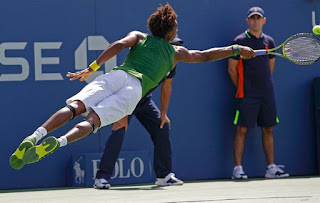
But the hands have failed him from time to time: the inability to handle the short slice, the tendency to receded further and further into the backcourt, and the almost psychological dependence on his athleticism to entertain (and not necessarily to win), have all belied the very profligacy of talent that coaches and the tennis punditry has bemoaned. Darren Cahill once claimed that Monfils would, from time to time, skip a (second and) afternoon practice with his coach, Roger Rasheed, claiming he need a rest, only to find him later in his room hotel room hootin' and hollerin' while working up a sweat playing FIFA soccer on the playstation. So perhaps something within him realized that there was a limit to how far he needed to develop himself physically (Rasheed's specialty), when the most critical tool available to him (his hands) remained unaddressed.
Maybe he knew something that we didn't?
This week, after having hired his Swedish coach Mikael Tillstrom in October of last year, worked on simplifying his game, and more specifically the technique on his serve, the Gael Monfils taking the court today in his second successive final (if 5 years after the first), has shorn his infamous locks, and some of the more elaborate machinations that have frustrated his least loyal fans. The gale force wind at his back may be the new and improved serve, imperceptibly more rhythmic, but palpably more effective, has elicited only 2/3rd as many aces (42) as his infamous serving opponent (66). He will need all the free points he can get to reduce his burden of proof that Karlovic might not get through a WTA field would it were not for that monstrosity of a first serve.
The jury is not out on either of their careers today, but the perceived quality of the final, will be largely dependent on the extent to which an entertainer can get down to business and mitigate the reputation (at least) of a 5-19 record in ATP finals.
Those doubts, whispered by the most pessimistic, weren't doused by his quarterfinal loss of a match, and a shot at history, in the Boys Singles draw of the 2004 US Open: in fact they were given a loud and undeniable voice. His absence from the final, contested by Sergiy Stahkovsky and Andy Murray, a pair who would carry on a different kind of tete a tete this year following Indian Wells, was all but forgotten when he began a full time career on the ATP tour. Launching himself into the top 50 with victories at 2 challengers and a full ATP event in Sopot, he was overshadowed only by the player that French tennistas have always truly believed to be the rightful heir to the legacy of Les Mousquetaires. In fact Gasquet may have done him a favor by beating Roger Federer in Monte Carlo, putting the "bleu, blanc et rouge" bullseye at Roland Garros squarely on his back, where it didn't belong. Monfils has actually had the most consistent results of all his contemporary countrymen at their home major, (if not the best, with Tsonga reaching one more semifinal).
But since that early promise, despite remaining one of, if not the most, athletic player(s) in the game today, and the evolution of the game making raw athleticism more and more of a common trait (if not distinguishing), Monfils has not translated that into commensurate success at the highest echelons of the game. I have always suspected that while every other part of his body screams exceptional, the most critical tools in his tennis kit remain curiously ordinary: his hands. While Simon uses his to swash, Gasquet uses his to swashbuckle and Tsonga uses his to simply buckle, Monfils' hands, hardly the most sophisticated in the world, form the basis of little more than a human backboard. No shot seems out of his reach, unless he decides otherwise, and it's a considerable reach.

But the hands have failed him from time to time: the inability to handle the short slice, the tendency to receded further and further into the backcourt, and the almost psychological dependence on his athleticism to entertain (and not necessarily to win), have all belied the very profligacy of talent that coaches and the tennis punditry has bemoaned. Darren Cahill once claimed that Monfils would, from time to time, skip a (second and) afternoon practice with his coach, Roger Rasheed, claiming he need a rest, only to find him later in his room hotel room hootin' and hollerin' while working up a sweat playing FIFA soccer on the playstation. So perhaps something within him realized that there was a limit to how far he needed to develop himself physically (Rasheed's specialty), when the most critical tool available to him (his hands) remained unaddressed.
Maybe he knew something that we didn't?
This week, after having hired his Swedish coach Mikael Tillstrom in October of last year, worked on simplifying his game, and more specifically the technique on his serve, the Gael Monfils taking the court today in his second successive final (if 5 years after the first), has shorn his infamous locks, and some of the more elaborate machinations that have frustrated his least loyal fans. The gale force wind at his back may be the new and improved serve, imperceptibly more rhythmic, but palpably more effective, has elicited only 2/3rd as many aces (42) as his infamous serving opponent (66). He will need all the free points he can get to reduce his burden of proof that Karlovic might not get through a WTA field would it were not for that monstrosity of a first serve.
The jury is not out on either of their careers today, but the perceived quality of the final, will be largely dependent on the extent to which an entertainer can get down to business and mitigate the reputation (at least) of a 5-19 record in ATP finals.
2016 CITI OPEN FINAL THOUGHTS: LIKE IT OR NOT...IVO KARLOVIC JUST KEEPS COMING
3 years Ivo Karlovic nearly died.
He woke up one morning with numbness in his arm, that began to spread throughout his body. A professional athlete, aged 34, he was accustomed to waking up with the creaky quality of a locomotive that takes a few strokes of the pistons to get up to speed. But you just keep on moving and you get over it. After all, there comes a time when, after years on tour, a player begins to wonder when is going to be the day that they wake up and the little engine just can't. Agassi, in his excellent memoir Open, talked about the skittish assurance of moving one limb at a time, hoping the capacity to compete would come to him in stages, towards the end of his career. The anxiety never goes away, but a player grows accustomed to the uncertainty, both of which are resolved despite the uncomfortable feeling of one's body working through its nightly torpor.
But this was different. The numbness persisted. And his speech was slurred.
A house call from the paramedics brought relief that didn't last long, which is probably a good thing, because that would have sounded the alarm bells of doctors who didn't know if this professional athlete was having a stroke, or had an undetected brain tumor that wouldn't reveal itself. Unlike the case of Leander Paes' diagnosis of neurocysticercosis (a parasitic infection that causes brain abscesses that can look like tumors) they would have hoped for a best case scenario - strange to contemplate under the conditions - of a bacterial infection that could be treated by ever increasingly powerful and specific antibiotics.
But that too failed to resolve what had befallen Karlovic. His wife Alisi and his (still to this day) coach Petar Popović by his side as he went in and out of consciousness, it wasn't at all clear that he would recover at all, or well enough to regain normal functions - to say nothing of the very real possibility that the least negative of all outcomes would be the end of his career. Eventually the case was diagnosed as viral meningoencephalitis and after 10 days of treatment a few days of monitoring he was released from that hospital in Miami that nearly became the first stop the way to his final resting place.
But like that thunderbolt raining serve of his, Karlovic just keeps coming. He's 37 years old, has wins over some of the best players in the history of the game (Federer, Hewitt), and one has the feeling that if his serve carries on like this he could play until he was 47. He bristles at the notion, but Karlovic's game is not the equal of his contemporaries...not by a long shot. We all know this, his opponents know this, we all try to avoid saying this and he himself will look you dead in the eye and deny this.
But that doesn't make it any less certain. So how has he managed?
But that doesn't make it any less certain. So how has he managed?
Well, over the course of his career, he has maintained a 92% 1st serve point win percentage, and if he keeps his 1st serve percentage above 55% (which he has, by a long shot) he is more or less guaranteed to at least take the set to a tie-break against the vast majority of his opponents. In fact, Karlovic has played and won half of his sets this week with tie-breaks. He hasn't dropped a set, and he hasn't been broken...not once. I'm guessing he hasn't even experienced a mini-break in those tie-breaks. So if he is to win his final over Gael Monfils today, it won't be because he's got great hands, or moves well, or even overwhelming power from the backcourt. But that shouldn't diminish the admiration for the one quality that characterizes his personality, his serve, his career and his run at the 2016 Citi Open.
Like it or not, Ivo Karlovic...just...keeps...on...coming.
Thursday, July 21, 2016
2016 CITI OPEN DAY 6: THE YANKS ARE COMING
Maybe it was the chronological proximity to the Olympic games, or
the Davis Cup, or the Rogers Cup. For whatever reason, the main draw of the 2016
Citi Open played host to 17 Americans. As young as 18, as old as 31, the door seemed to be open to anyone with a navy blue passport and a forehand. At just a hawk-eye's margin under 1/3rd of
the field, it seems the only American tennis players who didn't appear for DC's premiere annual international sporting
event, were the 10 names that encircle the stadium court as previous champions. Which brings me to the subject of the Day 6 recap: there remains (for the 9th year running) a curious gap in the long tradition of
American success at this event, which collides in history with the last American
to win a major - one Andrew Stephen Roddick. Given the excitement surrounding the many supplicants who would gape to be
his heir, both as the titlist here, and the next American world champion (with a "Y" chromosome), it begs a brief history of those yankee doodle dandies who've
brought the bacon home from DC.
Now, if Donald Dell, John Harris and Steve Potts had had their way, I'm
quite certain that the American they would have chosen to win the inaugural
event in the nation's capital, would have been the man who's vision it was to do
more than put the same complexioned asses in the seats over and over again. After all, who
but Arthur Ashe could have elicited the integrated audience that the socially
conscious men behind the curtain had hoped for, and indeed achieved, in the
first (and last) 5-set final in the history of the tournament in
1969. On that day, everyone in the audience had hoped for a victory from
the man born and raised 90 miles away in that other US capital (of the
Confederate States of America). His effort was herculean, albeit erratic, losing the first two advantage sets, with the second lasting 16 games. And although he found his feet in the 3rd and penultimate sets, try as he and
everyone watching did, his loosed-limbed, left handed Brazilian opponent on the
day, Thomas Koch, simply would not yield the right of way.
A year later, an American champion was guaranteed, as Ashe
returned to compete for the final against Cliff Richey, a bare-knuckled brawler
born of Texas tennis royalty. His sister Nancy Richey is an ITHOF inductee
who won the Australian Championships in 1967, and the first French Open in 1968, to go with 3 other majors in doubles. Ashe would gain some measure of revenge when it counted, when he beat Richey two years later in a US Open semi-final...but on that day, the stars at night shone bright for the big heart from Texas.
The Aussies took over the next couple of years, when Rosewall and Roche (in succession) disposed of the same Marty Riessen, denying the Illinois native his place on the ring of champions at the William H. Fitzgerald Tennis Center. So it wasn't until 1973 that Ashe finally fulfilled the promise envisioned 5 years earlier and won the title to the delight of the partisan audience. In a replay of the first US Open final (also 5 years earlier) Ashe defeated the wily, but altogether over-matched, dutchman Tom Okker, who had made a(n almost forgotten) kind of history himself by being the first Jewish tennis player to make a major final in the Open era. In 1974 another American son of Abraham, Harold Solomon, ascended to the top row of the annals of Citi Open history, by beating none other than 3-time champion Guillermo Vilas, who wouldn't lose another final here until 1981.
The Aussies took over the next couple of years, when Rosewall and Roche (in succession) disposed of the same Marty Riessen, denying the Illinois native his place on the ring of champions at the William H. Fitzgerald Tennis Center. So it wasn't until 1973 that Ashe finally fulfilled the promise envisioned 5 years earlier and won the title to the delight of the partisan audience. In a replay of the first US Open final (also 5 years earlier) Ashe defeated the wily, but altogether over-matched, dutchman Tom Okker, who had made a(n almost forgotten) kind of history himself by being the first Jewish tennis player to make a major final in the Open era. In 1974 another American son of Abraham, Harold Solomon, ascended to the top row of the annals of Citi Open history, by beating none other than 3-time champion Guillermo Vilas, who wouldn't lose another final here until 1981.
In the interim, Vilas alternated titles with Americans for 6
years (missing the 7th by losing to his professional nemesis, and elegant compatriot, Jose Luis Clerc. Jimmy Connors, by then the most
imposing player in the world, both technically and in terms of his influence on
the game, took the bicentennial year title in 1976, then won a second two years
later against Eddie Dibbs. In a repeat of their memorable, but lightly attended consolation (3rd place) match in 1971, Connors still had the better
of his less illustrious compatriot. Had he entered the tournament in
1980, it’s not altogether certain that he would have won it. Though
Connors record on clay was exemplary by the standards of mere mortals, for
those whose faces grace the Mount Rush(the net)more of tennis, clay was by far
his worst surface managing only one major title on the slippery stuff, and that
in the familiar surroundings of the West Side Tennis Club at Forest
Hills - also in 1976 (over Bjorn Borg, no less, but I digress).
The best American on clay in 1980 was Brian Gottfried, who
was enjoying one of the most successful years of his career, and nobody had
worked harder to earn his place in Citi Open Valhalla than
him. Gottfried was the kind of player who would (and in fact did) only take one day off from practice...the day he got married. That
year, Gottfried earned his title by holding at bay the man most Argentine
tennis fans pitted against their beloved Vilas, as the fairest fuzz whacking
gaucho of them all. It would be his one and only title in Washington
DC.
Although a couple of Bollitieri Academy graduates (Jimmy Arias in 1982 and 1983, Aaron Krickstein in 1984) tried their best, the title escaped American possession until Jimmy Connors, in a prodigal return, killed two bald eagles with one stone, ending his own personal 4-year title drought, and one twice that long for Americans at the Citi Open, with a victory over the talented and languid, pre-Roland Garros conquering Ecuadoran Andres Gomez. Connors initiated an American revival, resulting in titles for the Red, White and Blue in 9 of the next 12 years. This sequence would include all 5 of Agassi’s titles (1990, 1991, 1995, 1998, 1999), both of Michael Chang’s (1996, 1997) and Tim Mayotte's lone title in 1989, which would have been American either way because his opponent that year was Brad Gilbert.
With so many Americans enjoying their 15 minutes at the DC troth,
one could have been forgiven for assuming that the trend would continue ad
infinitum. The trend was eventually proven illusory, but Roddick surprised everyone
with a victory over Sjeng Shalken in 2001 for his maiden title here (and the
third of his rookie year) followed by an even bigger surprise the
next year when James Blake won his one and only title, over Paradorn Shrichipan,
having precociously usurped Andre the Giant in the
semi-final. Unfortunately Blake’s interlude as the American standard
bearer was short lived, both in the grand scheme of things and at this
tournament. Roddick would match his one-time American coach Jimmy
Connors with 3 titles, his third (and last) would also spell the latest of an
amazing tally of 19 titles in 45 years...four better than a third, and four shy of
half.
So who then, among the band of brothers still in the field is most likely to make their maiden title in DC #20 for the US of
A?
Well, there is the record holder for profligacy, 3-times bridesmaid John Isner, who’s professional breakthrough came at this very tournament, when Roddick last carried the flag. That year, Tommy Haas joked that there ought to be a height limit on tennis players, after falling to the long-limbed tarheel in a 3rd set tie-break. Last year Isner fell to the fastest hands in the (far) east, in a gripping final against Kei Nishikori. This year, a well earned victory over Marcos Baghdatis, a natural talent who counts his return of serve as one of his weapons, is a good sign: that's because it seems to be the only kind of a player with a snowball's chance on a summer afternoon in DC, of beating him on that lightning quick Stadium Court. James Duckworth, didn't benefit from any hangover from Isner's Davis Cup disappointment. It could turn out to be a delayed reaction, and he will need all his reserves of fortitude to overcome his opponent in the quarterfinal.
Well, there is the record holder for profligacy, 3-times bridesmaid John Isner, who’s professional breakthrough came at this very tournament, when Roddick last carried the flag. That year, Tommy Haas joked that there ought to be a height limit on tennis players, after falling to the long-limbed tarheel in a 3rd set tie-break. Last year Isner fell to the fastest hands in the (far) east, in a gripping final against Kei Nishikori. This year, a well earned victory over Marcos Baghdatis, a natural talent who counts his return of serve as one of his weapons, is a good sign: that's because it seems to be the only kind of a player with a snowball's chance on a summer afternoon in DC, of beating him on that lightning quick Stadium Court. James Duckworth, didn't benefit from any hangover from Isner's Davis Cup disappointment. It could turn out to be a delayed reaction, and he will need all his reserves of fortitude to overcome his opponent in the quarterfinal.
Speaking of which, could Steve Johnson be the most likely to end the American drought in DC? Already a winner at Nottingham this year, his respectable 4th round performance against Roger Federer at Wimbledon, may signal a coming of age for him. He is (as is to be expected) older than players with similar experience on the ATP tour, but this is the first year Johnson's game is a match for his commitment to give every last drop of effort in him to his own cause. He (very) effectively blunted the potency of Ryan Harrison's serve with a series of clever and effective chip returns to the deep recesses of the court.
This is precisely the location of Nishikori's most effective returns last year against Isner, and I have a feeling that if he's feeling it at all in the legs, he will have neither the energy, nor the inclination to make the court smaller by serving and volleying - the only viable reply to Johnson's rather obvious, but even more effective, solution. And as hard as it is to imagine it, his serve may be even more effective this year than last, and Isner struggled to find it then. So, this could be the Trojan man's moment, and if he can get past Isner, there aren't too many players left in the field with all tools necessary to push him back down the walls of Troy.
This is precisely the location of Nishikori's most effective returns last year against Isner, and I have a feeling that if he's feeling it at all in the legs, he will have neither the energy, nor the inclination to make the court smaller by serving and volleying - the only viable reply to Johnson's rather obvious, but even more effective, solution. And as hard as it is to imagine it, his serve may be even more effective this year than last, and Isner struggled to find it then. So, this could be the Trojan man's moment, and if he can get past Isner, there aren't too many players left in the field with all tools necessary to push him back down the walls of Troy.
Then there's Sam Querey: another quiet American who (to this day, despite all his megaton serving contemporaries) still holds the ATP record for the most consecutive aces in a single match (10 against James Blake in 2007). Surprising some with a magnificent effort to overcome 2012 Champion Alexander Dolgopolov tonight, Querrey showed that, more than an anomaly in his summer, his victory over Djokovic at Wimbledon foretells a resurgence in his career that could lead to him winning a title here that he has sought since 2009. To do this, he will need all the free points he can get from his serve against a man who has been putting on a serving exhibition here himself: the flash, flamboyant Frenchman Gael Monfils, who has hit 22 aces in 2 matches. If Monfils is taking himself seriously, he has the pedigree to douse the fire lit in Querrey. But if that Gallic Shrug, combined with the circus shots he sometimes tries, makes another appearance, I like the chances of (the) Sam(urai) Querrey.
Finally there's Jack Sock, who, in addition to hitting a tennis ball harder than anyone ever has, is apparently running for president. I have always been of the opinion that if you want to know who has a shot to be the best player in the world, look for the guy that's doing something that nobody else can: Alexander (the Great) Zverev is hitting his groundstrokes at an average speed of 81 mph - 6 mph faster than anyone else at the Citi Open. Nick Kyrgios displays Federer-ish combinations of accuracy, variety and disguise on his serve. And Jack Sock is hitting his forehand at as much as 6300 rpm...Rafael Nadal, the former King of Spain, maxes out at 5800 (with all due respect to Federer's slice backhand that reaches 7200 rpm...but that's a very different kettle of fish).
So this is a tool in Sock's sock that is exclusive to him - it's his Excalibur, his Aegis, the ring of which he is the Lord...and boy did he put it to good use today. Like a game of cat and mouse played by men with racquets, he used his rpm to consistently force Daniel Evans into a series of very limited choices, most of which ended with him lancing the boil of Evans' frustration with a screaming forehand winner. The minute Evans left a shot not quite far enough into Sock's backhand corner to...well, force him to hit a backhand, Sock began ripping his forehand, really heavily and at an acute angle, into Evans' backhand.
It was neither deep nor short, and if Evans tried to step in and come over it, the ball would jump up into his chest and he would invariably framed it. If he moved back, the court would open like a sliced grapefruit, beckoning Sock to exploit the now gaping wound that was Evans' forehand corner. And if Evans tried to slice it, he could get away with it a couple of times, maybe even three, but eventually the temptation to exit from that constrictive tango was too much. He couldn't resist trying to go up the line, either an error, or a short ball would ensue, and Sock would simply put him out of his misery or start the sequence again.
It was almost sadistic: a lesson in humility that Mr. S(p)ock can impose on his opponents like the Kobyashi Maru. Time and again, Evans made a choice, and time again it ended in a fatal exercise in total futility. Strangely, although Evans is not the fittest fiddle in the orchestra, he seemed to grow in efficacy as the match wore on, after very nearly losing the first set in a 20 minute bagel. But Sock's superior movement, serve and that blood-thirsty sword of Damocles (masquerading as a forehand) he wields eventually dropped right on top of Evans' head.
I have the feeling that of all the players that US has produced in the last 10 years, Sock's game is the most likely to achieve a major title. At the height of his powers, nobody has an answer to what he can do, which is why it is such a shame that he so rarely reaches that apex. The likelihood of doing so over a fortnight, which would be required to drink of the immortal ambrosia reserved for his major winning American predecessors, is for the moment, remote. But ask me if he can do it over the next 3 days, and I would argue that is hardly a bridge, over the Potomac, too far.
So, if I had to place a bet on who wins the Citi Open, I would drop a 10 euro note on Sasha "Fierce" Zverev. But if the currency must be green, with dead presidents (perhaps poetically, given that we're 6 miles from the National Mall) I'd place it on John "the Hitman" Isner. If (and it's a pretty big if) he can get past the Trojan dark horse, he is a better player with a better serve than Karlovic, who I think will take the racquet right out of Sock's hand in their quarterfinal, rendering his wizardry entirely moot. Querrey is unlikely to get past Monfils, and if he does, his reward would be a date with Zverev in the semi-final, and I don't see him bringing that Chincoteague pony to heel any time soon.
The one and only player that can take the racquet out of Zverev's hand is Isner - let's just hope he brings it in what would be his 4th final. He already holds the record for runner-ups at the Citi Open, and I'm quite certain he doesn't want to pad it.
Finally there's Jack Sock, who, in addition to hitting a tennis ball harder than anyone ever has, is apparently running for president. I have always been of the opinion that if you want to know who has a shot to be the best player in the world, look for the guy that's doing something that nobody else can: Alexander (the Great) Zverev is hitting his groundstrokes at an average speed of 81 mph - 6 mph faster than anyone else at the Citi Open. Nick Kyrgios displays Federer-ish combinations of accuracy, variety and disguise on his serve. And Jack Sock is hitting his forehand at as much as 6300 rpm...Rafael Nadal, the former King of Sp
So this is a tool in Sock's sock that is exclusive to him - it's his Excalibur, his Aegis, the ring of which he is the Lord...and boy did he put it to good use today. Like a game of cat and mouse played by men with racquets, he used his rpm to consistently force Daniel Evans into a series of very limited choices, most of which ended with him lancing the boil of Evans' frustration with a screaming forehand winner. The minute Evans left a shot not quite far enough into Sock's backhand corner to...well, force him to hit a backhand, Sock began ripping his forehand, really heavily and at an acute angle, into Evans' backhand.
It was neither deep nor short, and if Evans tried to step in and come over it, the ball would jump up into his chest and he would invariably framed it. If he moved back, the court would open like a sliced grapefruit, beckoning Sock to exploit the now gaping wound that was Evans' forehand corner. And if Evans tried to slice it, he could get away with it a couple of times, maybe even three, but eventually the temptation to exit from that constrictive tango was too much. He couldn't resist trying to go up the line, either an error, or a short ball would ensue, and Sock would simply put him out of his misery or start the sequence again.
It was almost sadistic: a lesson in humility that Mr. S(p)ock can impose on his opponents like the Kobyashi Maru. Time and again, Evans made a choice, and time again it ended in a fatal exercise in total futility. Strangely, although Evans is not the fittest fiddle in the orchestra, he seemed to grow in efficacy as the match wore on, after very nearly losing the first set in a 20 minute bagel. But Sock's superior movement, serve and that blood-thirsty sword of Damocles (masquerading as a forehand) he wields eventually dropped right on top of Evans' head.
I have the feeling that of all the players that US has produced in the last 10 years, Sock's game is the most likely to achieve a major title. At the height of his powers, nobody has an answer to what he can do, which is why it is such a shame that he so rarely reaches that apex. The likelihood of doing so over a fortnight, which would be required to drink of the immortal ambrosia reserved for his major winning American predecessors, is for the moment, remote. But ask me if he can do it over the next 3 days, and I would argue that is hardly a bridge, over the Potomac, too far.
So, if I had to place a bet on who wins the Citi Open, I would drop a 10 euro note on Sasha "Fierce" Zverev. But if the currency must be green, with dead presidents (perhaps poetically, given that we're 6 miles from the National Mall) I'd place it on John "the Hitman" Isner. If (and it's a pretty big if) he can get past the Trojan dark horse, he is a better player with a better serve than Karlovic, who I think will take the racquet right out of Sock's hand in their quarterfinal, rendering his wizardry entirely moot. Querrey is unlikely to get past Monfils, and if he does, his reward would be a date with Zverev in the semi-final, and I don't see him bringing that Chincoteague pony to heel any time soon.
The one and only player that can take the racquet out of Zverev's hand is Isner - let's just hope he brings it in what would be his 4th final. He already holds the record for runner-ups at the Citi Open, and I'm quite certain he doesn't want to pad it.
Subscribe to:
Posts (Atom)